Positions
The positions he has argued in public, each stated as he states it and each already borne out somewhere in the record: twenty-three of his thirty-three graded calls landed, and twenty-four of these positions were later adopted by the people he addressed. The earliest statements are quoted further down; the dates do the arguing.
- Your data is your property.Personal data should be treated as property protected by the Fifth Amendment; uncompensated commercial use is a taking. He has argued this since 2021 and watched data-as-property bills reach Congress and state legislatures in 2026.
- Publishing is filing.Original conception, published under a verified identity, should establish priority. First-to-file rewards capital; a public timestamp rewards the inventor.
- Automate the protection of ideas.The Patent and Copyright offices should interoperate with the platforms where ideas are first disclosed, registering and timestamping conception automatically.
- Censorship is an economic act.Shadow-banning and demonetization suppress the value of a person's work and thought; he coined #TheftOfThought in 2022 and has pressed inspectors general, the FTC and Congress for transparency.
- Waste, fraud and abuse that persist become economic treason.Systemic misuse of public and private data, left uncorrected, deserves a category of its own, and a bill to match.
- Inflation is a shortage of innovation.Price stability follows productive capacity; an indexed currency tied to population and discovery would beat interest-rate management.
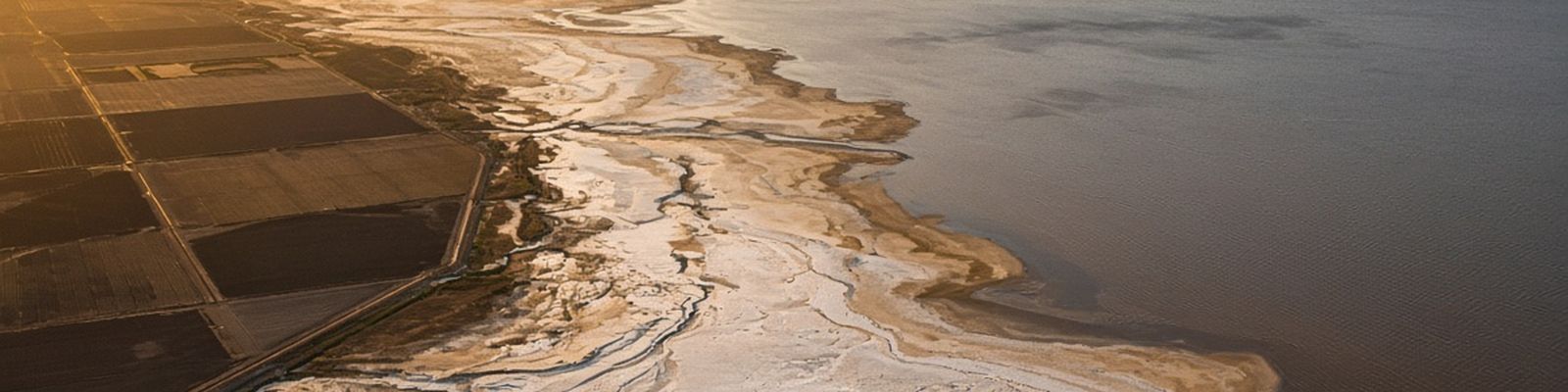
- Clean water is an agricultural design problem.Hydroponic forage crops cut water use by roughly ninety percent and remove plastic and runoff from the system; the Salton Sea can be a renewable-energy region instead of a liability.
- Redress is a live right.The First Amendment's petition clause is a working mechanism, not a relic, and quantifying grievances is how it becomes enforceable.
- America cannot afford a modern civil war.Domestic fracture is a national-security failure; the fix is institutional transparency and a digitally literate civics.
- Trust has to be rebuilt from sources up.There are no trusted sources anymore; the remedy is provenance, timestamps and open records, not louder authority.
Read the article as prepared in session, 2026-06-20
There Are No Trusted Sources Anymore**
In today’s world, blind faith in any institution, outlet, or expert feels like a luxury we can no longer afford. The idea that certain voices or organizations sit above the fray as neutral arbiters of truth has collapsed under the weight of repeated errors, selective framing, and outright failures. We live in an age of information abundance, yet reliable guidance feels scarcer than ever.
Recent data paints a clear picture of eroded confidence. Gallup’s October 2025 poll found that just 28% of Americans have a “great deal” or “fair amount” of trust in mass media—newspapers, television, and radio—to report the news fully, accurately, and fairly. This marks a new historic low, down from 31% the prior year and far below levels seen even a decade ago. Broader surveys echo the trend: trust in government hovers around 17% according to Pew Research, while global measures from the Edelman Trust Barometer and GlobeScan show declining confidence across business, government, media, NGOs, and academia.
This isn’t mere cynicism. It stems from tangible experiences where “trusted” sources got major stories wrong or actively shaped narratives that later unraveled.
Take the Hunter Biden laptop story in 2020. A New York Post report detailed contents from a laptop abandoned at a Delaware repair shop, including emails suggesting influence peddling tied to then-candidate Joe Biden. Within days, 51 former intelligence officials signed a public letter claiming the story bore “all the classic earmarks of a Russian information operation.” Major media outlets amplified doubts, social platforms limited its spread, and the narrative of potential disinformation took hold. Years later, forensic analysis, court proceedings (including Hunter Biden’s own legal cases), and admissions confirmed the laptop’s authenticity with no credible evidence of Russian fabrication.
Or consider the early COVID-19 origins debate. The possibility that the virus escaped from the Wuhan Institute of Virology was quickly labeled a conspiracy theory by many prominent media voices and scientists. It was tied to political figures and downplayed through papers and reporting that emphasized natural spillover while sidelining lab-leak evidence. Over time, U.S. intelligence assessments (including from the FBI and Department of Energy) shifted toward viewing a lab incident as plausible or likely, and the initial dismissal looked increasingly premature.
These aren’t isolated missteps. They reflect deeper patterns: institutional incentives, ideological leanings, funding influences, and the pressure to align with prevailing narratives. Fact-checkers and “experts” often operate within the same echo systems they claim to police. Algorithms on social platforms reward engagement over accuracy, while AI tools now generate convincing text, images, and video that can mimic or distort reality at scale.
The result? A fragmented information landscape where legacy gatekeepers have lost their monopoly—and their credibility. No single outlet, agency, or academic body commands universal respect anymore. Even well-intentioned reporting can suffer from selection bias, incomplete context, or reluctance to challenge powerful interests.
Does this mean everything is fake or that truth is unknowable? No. It means we must abandon the outdated model of outsourcing our understanding to any one authority. Primary sources—raw government data from agencies like the Bureau of Labor Statistics or Census Bureau, original documents, court records, and direct evidence—remain valuable starting points when interpreted carefully. Diverse, independent voices across the spectrum can surface angles mainstream coverage misses. Cross-verification, skepticism toward incentives, and a willingness to update beliefs with new evidence become essential skills.
In practice, this looks like reading the actual studies or filings instead of summaries, comparing coverage from outlets with different leanings, and treating extraordinary claims with extra scrutiny regardless of who makes them. It means recognizing that even “reliable” sources have blind spots and that healthy distrust is not the same as blanket rejection.
The collapse of trusted sources isn’t a bug in the system—it’s a feature of a more transparent, democratized information age. We no longer have the luxury of passive consumption. The responsibility for sorting signal from noise now rests squarely with each of us. In that sense, the absence of universally trusted sources may ultimately force us toward something better: sharper thinking, greater personal accountability, and a relentless pursuit of what actually holds up under examination.
The old authorities have spoken. Now it’s time to listen critically—and decide for ourselves.
- Allies are measured by conduct.Apple's ecosystem is a stronger and closer strategic ally than several treaty partners — and also carries unpatched-device and government-tie risks worth naming.
- Security should come from physics, not math.A photonic, ones-only internet secured by the properties of light needs less encryption than one secured by key length — and seven billion intuitions are a larger search space than any key.
- Neurowarfare is a civil-liberties issue.Directed-energy and cognitive-domain threats belong in the same conversation as surveillance law and anomalous health incidents.
More positions, dated
- Encryption is a faith, not a security model
- “I told you encryption was a cult” (Sept 15, 2025). Security should rest on physics and ownership, not on keys the platform holds; the encryption industry sells a trust it cannot deliver (Apr 12, 2025).
- Zero trust means zero trust
- “We shouldn't accept signatures in place of evidence; it's the very basis of law” (Sept 7, 2024). A system that wants trust and zero trust at the same time has neither (Apr 7, 2023).
- Section 230 has a retroactive future
- Platforms that let the government into their daily operations are state actors; Section 230 “will have retroactive legal potential to the benefit of the ordinary citizen” (Jun 23, 2025).
- The education system is past broken
- Innovate education, universities included, and enforce accessibility compliance (Feb 4, 2024); without a decisive change, the country has roughly a decade (Aug 6, 2024).
- Prop 47 was bad legislation
- It increases police interaction and distrust without touching the actual issue (Jul 9, 2024); Californians rolled it back that November.
- Data ownership before tariffs
- The tariff framework damaged global relations; “#DataOwnership before #Tariffs, then wars will solve themselves” (Aug 30 and Sept 3, 2025).
- Farmers have a right to water that supersedes any entity's right to manage it
- Water is a right to life; regulation cannot supersede the people's ownership of it in the face of failed management (Nov 11, 2025).
- The federal hemp ban was wrong
- Opposed the hemp-THC restriction in the November 2025 spending bill and the Texas politics behind it (Nov 12, 2025).
- Impairment should be measured, not presumed
- Cannabis DUI enforcement should measure the individual's physiology through wearables rather than a blood level that ignores tolerance (Apr 3, 2025).
- Bitcoin is a conservative invention
- “I'm convinced #BTC was made by a conservative that never understood fiat” (Mar 15, 2024); stablecoins, not a central-bank digital currency, were always where the country would land (Aug 27, 2024).
- Israel should be strengthened, not directed
- “Don't force Israel to fight; strengthen them” — faster, stronger, smarter (Oct 16, 2025). Hostages are rescued, not traded.
- Raise conditions at the border rather than walls
- Hydroponic forage and water infrastructure in the border economy so that people want to stay (2019; to the President, Jan 18, 2024).
The positions in depth — desalination, the district's insolvency, the leagues, nuclear, education — are on the Casebook page; the arguments beneath them on the Arguments page.
The mountain-top misting system, and the water cycle it returns
ORDMS is an entry in the IP portfolio with its specification (June 4, 2025), in the application families there, and in the downstream table; this is the position.
- ORDMS: rehydrate the backside of the mountain
His position. “I'm imagining a system that connects along the top of the mountain range on the downward side of the orographic region that produces a mist that can then add an effective amount of moisture to the entire region below” (Jun 4, 2025) — the Orographic Region Downward Misting System, named and made his the same day. The goal, in his words: “increase humidity in an entire region exponentially to reduce evaporation exponentially, and increase plant life for increased above-ground collection and storage,” fed by solar atmospheric-moisture collection on the windward side and the leeward springs that could be turned to geysers. The physics he insisted the model had missed: “high moisture creates low pressure that then attracts high pressure that then falls back into low pressure instead of remaining high pressure — it exponentially changes the water cycle in the region.” High-moisture environments make high-precipitation environments, which make water abundance; the mist is the seed, not the supply.
The facts that bear it out. A rain shadow is the dry side of a range where descending air warms and holds its moisture; the leeward deserts of the Wasatch and the Sierra — Utah's basin, the Great Basin, the Mojave — are its product. Evapotranspiration recycling is documented: a third to half of inland rainfall in vegetated basins is water the land itself returned to the air. His design turns that loop on in a basin where it is off. On the Portfolio page with its specification.
- Downstream: what the mist returns
His position. The chain he asked the model to quantify and it undercounted: mist → humidity → evaporation falls from every reservoir, canal and furrow in the basin, which is water a farmer did not lose → soil moisture → plant cover → the plants' own transpiration adds to the humidity, compounding → low pressure forms over the moist region and draws the high-pressure air in → precipitation downwind where there was none → aquifer recharge and spring flow → the Colorado River gains yield “for years to come” → the valley's playa stops lifting as dust, which is the air his county's cancer and asthma record is written in → and, in Utah, the natural radiation bound by moisture and cover instead of blown.
The facts that bear it out. Lake Mead loses roughly 600,000 acre-feet a year to evaporation, Lake Powell about 400,000; a point of regional humidity reduces open-water evaporation measurably; vegetated ground holds dust that bare playa releases. Each link in his chain is a known mechanism; the design is the first to connect them deliberately on the dry side of a range.
- Downstream: what the forage returns
His position. Forage at ninety percent less water is the first link, not the whole claim. “Hydroponic forage reduces the land mass needed in farming to allow a rebirth of forest” (Aug 17, 2022) — and from there: acreage freed → forest and cover returned → the desertification he names hedged by efficiency rather than by import → runoff ended, so the Salton Sea stops receiving the chemistry that made it the valley's hazard → the lake's shrinkage slowed and the playa dust with it → the river water the forage no longer takes becomes the water that is paid for, that keeps the district solvent, that funds the Mexico deal that keeps Mexicans home → and the forest that returns cycles its own rain, which is the ORDMS effect produced by crops instead of mist. The two concepts are one hydrology: efficiency on the farm and humidity on the mountain, both aimed at the same river.
The facts that bear it out. Imperial Valley agriculture uses about 2.6 million acre-feet a year, most of it on forage; the New River and the Alamo River carry its runoff to the Salton Sea; the Lower Colorado programs now pay for every acre-foot not used. His 2019 arithmetic — the valley's forage at a tenth of the water — is the largest single conservation that has not been built.